How to Use the MECE Principle to Create Clear and Structured PowerPoint Presentations
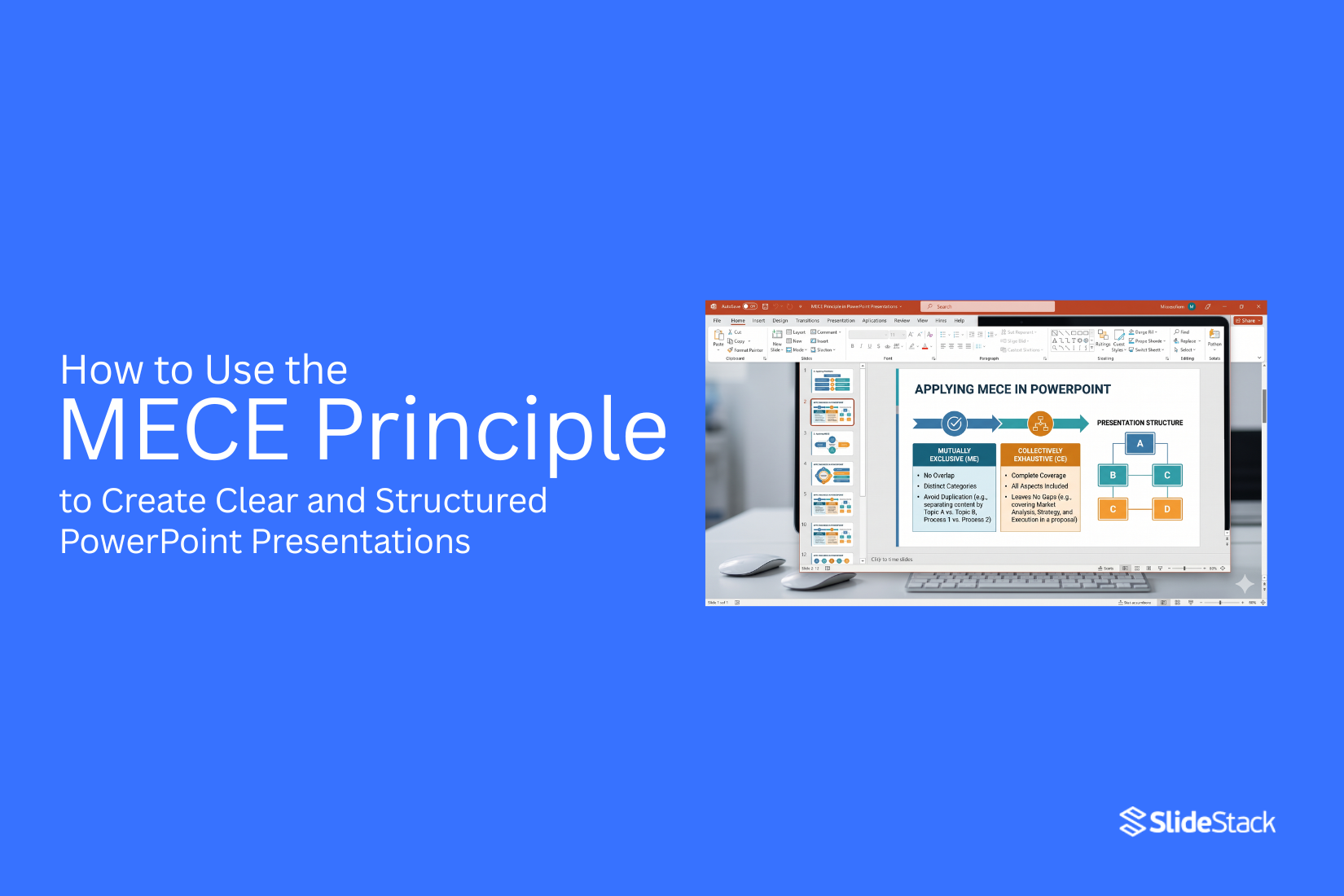
PowerPoint presentations often fail for reasons unrelated to design or data quality. The problem comes from unclear structure, repeated ideas, and missing connections between points in practice. Slides may contain strong information, yet the message feels scattered and hard to follow for audiences.
The MECE principle solves this by organizing ideas into groups that do not overlap and together cover the full topic. Each slide and section gains a clear role, which reduces confusion and strengthens the flow of information across the presentation. This approach supports better decision making because every idea is placed in a defined category with no overlap or gaps. Presentations become easier to follow and explain.
What is the MECE principle?
The MECE principle is a way to group information so every item is covered without overlap. MECE stands for Mutually Exclusive, Collectively Exhaustive. Mutually Exclusive means each item belongs to only one group. Collectively Exhaustive means all possible items are included. This prevents overlap and avoids missing any option.
Businesses use this principle in problem-solving, brainstorming, and project planning. It helps teams break large problems into clear parts. Each part stays separate from the others. All parts together cover the full problem. Consultants also use MECE in presentations to organize ideas in a clear structure. It helps clients follow complex discussions with less confusion.
Why the MECE Framework Matters in PowerPoint Presentations
PowerPoint limits how information is processed. Each slide has limited space. The audience reads and listens at the same time. This creates a cognitive load. Too much content reduces clarity. Messages become harder to follow. Ideas compete for attention instead of building understanding.
MECE helps structure this pressure. MECE stands for mutually exclusive and collectively exhaustive. It sets a clear rule for grouping ideas. Each item belongs in one place only. All items together cover the full topic. This reduces confusion in slide structure.
Many presentations fail due to overlap in categories. Teams often list “Sales,” “Revenue,” and “Income” as separate sections. These ideas often repeat the same meaning. Slides start to repeat content. The audience sees repetition instead of structure. The message becomes unclear and scattered.
This pattern breaks the rule of mutual exclusivity. One idea sits in more than one group. The structure loses precision. The slide deck becomes harder to scan. The audience spends more effort linking ideas. That effort reduces focus on the main message.
MECE removes this problem by forcing a clear separation of ideas. Each category stays distinct. Each slide has a defined role. The full set of slides covers the topic without overlap. This structure supports clearer communication and stronger understanding.
How the MECE Principle Improves PowerPoint Presentations
The MECE method helps build clearer slide decks. It separates ideas so each part has a clear place. This reduces confusion and keeps the message steady from start to end.
Eliminating Overlapping Information
Slides often repeat the same ideas without meaning to. This creates noise in the message. MECE removes that problem by splitting ideas into separate groups. Each slide carries one idea. Nothing repeats across sections. The audience sees clean and direct points. This makes the deck easier to follow.
Ensuring Complete Topic Coverage
Some presentations miss key parts of a topic. Others focus too much on one area and ignore the rest. MECE solves this by breaking the topic into full parts that fit together. Each section covers a specific angle. All parts together cover the full topic. This helps avoid gaps in the message.
Creating a Logical Storyline
Many slide decks feel scattered. Ideas jump from one point to another without clear order. MECE builds structure by placing ideas in a clear sequence. Each section leads into the next without confusion. The audience can follow the flow step by step. The message feels steady and organized.
Making Complex Information Easier to Understand
Large topics can feel heavy and hard to follow. MECE breaks them into smaller parts. Each part focuses on one clear idea. This reduces mental strain for the reader. The audience can process one section at a time. The full topic becomes easier to grasp through a simple structure.
Applying MECE When Planning Your Presentation
Clear planning shapes a strong presentation. MECE helps you break ideas into parts that do not overlap and do not leave gaps.
Defining the Main Objective
Start with one clear goal for the presentation. This goal sets direction for all slides. Every section should support it in a direct way. A single focus keeps the message steady and easy to follow.
Identifying Key Presentation Sections
Break the topic into main sections. Each section should cover one part of the story. No section should repeat another. This step builds structure and gives the presentation a clear path from start to finish.
Grouping Related Ideas into Distinct Categories
Ideas often appear in mixed forms at first. Sorting them into groups brings order. Each group should hold related points only. Separate groups stop overlapping and reduce confusion across slides.
Checking for Missing Topics and Redundancies
Review the structure after grouping. Look for gaps where key points are missing. Also, check for repeated ideas across sections. A clean structure has full coverage without repeated content. This step keeps the flow tight and clear.
How to Structure Presentation Agendas Using MECE
A MECE agenda breaks a presentation into clear parts. Each part has a clear role. No topic repeats. Every idea fits in one place. This helps the audience follow the message with less effort.
Creating Clear Main Sections
Start with the main parts of the presentation. Each main section should cover one big idea. Each section should stand alone. It should not repeat other sections. Keep the number of sections small. Too many sections make the flow hard to follow.
Organizing Subtopics Without Overlap
Each main section can have smaller subtopics. Each subtopic should stay in its own space. Do not place the same idea in more than one subtopic. Each subtopic should support only one main section. This keeps the structure clean.
Building a Logical Presentation Sequence
Place sections in a clear order. Start with basic ideas first. Move toward deeper points later. Each section should connect to the next in a natural way. The flow should feel steady and easy to follow. A strong order helps the audience understand the message step by step.
Example of a MECE Agenda Structure
Main Topic: Market Overview
• Section 1: Market Size: Covers total market value and scope.
• Section 2: Customer Groups: Covers different types of customers.
• Section 3: Competitor Landscape: Covers key competitors and their positions.
• Section 4: Growth Drivers: Covers the main factors that affect growth.
Using MECE to Organize Individual Slides
Each slide should carry one clear idea. That idea should not overlap with another slide. This is where MECE helps. It keeps ideas separate and complete. Start with the main message of the slide. Keep it focused on a single point. Add only details that support that point. Remove anything that repeats the same idea in a different form.
A slide works better with a clear structure:
• One core idea per slide
• Supporting points tied only to that idea
• No repeated concepts across slides
This structure reduces confusion. It also makes each slide easier to follow during a presentation.
Applying MECE to Different Presentation Types
Different presentations need different structures. MECE still applies in each case. Business presentations often need clear sections like problem, analysis, and solution. Each section should stay separate. Overlap between sections weakens clarity. Training presentations focus on learning steps. Each step should stand alone. Earlier steps should not repeat later steps.
Sales presentations focus on value and proof. One slide can show benefits. Another slide can show evidence. Each slide should serve a single purpose. Across all types, the goal stays the same. Each part should cover its own space without repeating others. The full presentation should cover everything needed without gaps.
Practical Examples of MECE in PowerPoint
A marketing report slide can show one segment per slide. One slide covers customer group A. Another slide covers customer group B. No overlap exists between them. A project update can split work into phases. One slide shows planning. Another shows execution. A final slide shows results. Each phase stays separate.
A product pitch can divide content into features, benefits, and pricing. Each slide focuses on one area. The audience sees a clear path from one idea to the next. MECE brings order to slides like these. Each slide stays clean. Each message stays direct. The full deck becomes easier to understand.
Common Mistakes When Using the MECE Principle
MECE helps structure ideas in a clear way. Each part of a topic stays in its own group. This makes information easier to follow in slides. Some mistakes can still reduce its value.
Creating Categories That Overlap
MECE needs a clear separation between groups. Overlapping categories break this structure. The same idea may appear in more than one section. This creates repetition across slides. The message becomes less clear. Each category should hold a single type of information.
Leaving Out Important Information
A clean structure still needs full coverage. Some setups leave out key points. Gaps appear in the logic. The flow of ideas feels incomplete. The audience misses parts of the message. Every key point needs a place in the structure.
Using Too Many Categories
A large number of categories reduces clarity. Slides start to feel crowded. Each section becomes too small. The main idea gets harder to follow. A smaller set of strong groups keeps the structure focused. Each group should carry a clear meaning.
Forcing MECE Where It Does Not Fit
Not every topic divides neatly. A forced structure can weaken the message. The flow feels unnatural. Ideas lose their connection. A different structure can sometimes work better. MECE should support clarity, not restrict it.
Best Practices for Building MECE-Based Presentations
Strong presentations need structure. MECE helps build that structure. Each idea fits in one place. Nothing overlaps. Nothing feels random. The result is clear thinking on every slide.
Good practice makes this easier to apply. A few simple habits can guide the full process from planning to final review.
Start with a Presentation Outline
Begin with a clear outline. List the main ideas first. Keep each idea separate. Each point should cover one topic only. This sets a clear path for the rest of the slides. It also helps avoid mixing ideas later.
Use Consistent Slide Structures
Keep the same slide pattern across the deck. Use the same layout for similar content. This makes the presentation easy to follow. Titles should be clear and short. Content should stay focused on one message per slide. This helps the audience stay on track.
Validate Categories Before Designing Slides
Check the groupings of ideas before building slides. Each category should stand on its own. No overlap should exist between sections. Every point must fit in one place only. This keeps the structure clean and easy to understand.
Review the Presentation for Gaps and Duplication
Go through the full presentation after building it. Look for missing points. Look for repeated points as well. Each slide should serve a clear role. Remove anything that repeats or adds confusion. The final flow should feel steady from start to finish.
Tools and Techniques for Applying MECE in PowerPoint
MECE helps break ideas into clear parts. Each part stays separate. Nothing overlaps. This makes slides easier to follow.
Mind Mapping and Brainstorming Methods
Start with a central idea. Write related points around it. Each point should sit in its own space. Group similar ideas. Remove repeated ideas. This helps form clear buckets of content for slides.
Issue Trees and Logic Trees
An issue tree starts with one main question. Break it into smaller questions. Each branch covers one part of the topic. Keep each branch separate. This helps remove overlap. It also helps spot missing points.
Presentation Storyboarding
Storyboarding lays out slides in order. Each slide has one clear message. Arrange slides from start to end. Check that ideas flow in a clean path. Remove extra details that do not support the main point.
Using Slide Sorter View for Structure Reviews
Slide Sorter View shows all slides at once. Check the order of slides. Look for repeated ideas. Look for gaps in logic. Move slides to fix the structure. Keep each slide focused on one idea.
Final Notes
MECE helps structure PowerPoint presentations in a clear way. Ideas stay in separate groups. Nothing overlaps. The full topic gets complete coverage. This supports clearer business communication.
MECE is not just a fixed template. It is a way of thinking about information. It shapes how ideas are arranged. It reduces repeated points. It also lowers the chance of missing important details. The flow of ideas becomes easier to follow. Skill grows with practice. Breaking ideas into simple parts becomes more natural over time. This habit helps in planning slides and building clear presentations.
FAQs
Is MECE a requirement or a best practice?
MECE is not mandatory, but it works as a quality benchmark in executive and decision-focused presentations. Without it, thinking often feels unclear.
Can a presentation be partially MECE?
Yes. Some sections can follow MECE while others stay open for exploration. The key is clarity on where the structure is strict.
Does MECE apply to storytelling presentations?
Yes, at the structure level. A story can sit on top of a MECE structure without breaking logical flow.
Is MECE compatible with Agile or iterative work?
Yes. MECE defines structure, not process. Iteration changes detail, not category boundaries.
How detailed should MECE buckets be?
Only as detailed as the decision needs. Too much detail increases complexity without improving understanding.
Can the recommendation slide be MECE?
Yes. Recommendations can be grouped by distinct levers that together solve the problem.
Should visuals be MECE or the logic behind them?
The logic behind visuals should follow MECE. Visual design comes after structure.
How do you explain MECE to a non-consulting audience?
Use simple language: no overlap and no missing parts.
Is MECE useful for small presentations (5–10 slides)?
Yes. Small decks often show structure more clearly, so MECE becomes more visible.
What’s the biggest sign a deck is not MECE?
Frequent comments that one slide connects heavily to another because the boundaries are unclear.
Does MECE limit creativity?
It limits confusion, not creativity. Ideas still develop inside each group.
Can MECE change during a presentation?
No. Structure should stay fixed during delivery. Changes belong to revisions before presenting.
Should appendices follow MECE, too?
Yes. Especially if they may be reviewed without context from the main slides.
Can MECE apply to a single slide?
Yes. Lists, options, and criteria on one slide should also avoid overlap.
How do you test MECE without peer review?
Try moving each item into another group. If it fits elsewhere, the structure is not clean.
Is MECE more important than data accuracy?
No. Correct structure cannot fix wrong data, but correct data without structure is hard to use.
When should MECE be explicitly stated in a presentation?
Only in formal settings where rigor is expected, such as executive or board-level communication.


You may also be interested in ...

How To Create An Eye-Catching Portfolio
If you’re looking to create an eye-catching portfolio, this post will come in handy. In this article, you can find the easies...
23 Jun, 2024

How To Easily Create An Infographic
Infographics are the perfect way to make a presentation that will impact an audience, but their design and composition might...
08 Jun, 2024

PowerPoint Template Tips & Tricks You Ne...
PowerPoint seems to be an unknown world for many people, especially those who have been assigned to create a presentation out...
08 Jun, 2024