How to Showcase the Innovation Ambition Matrix Effectively
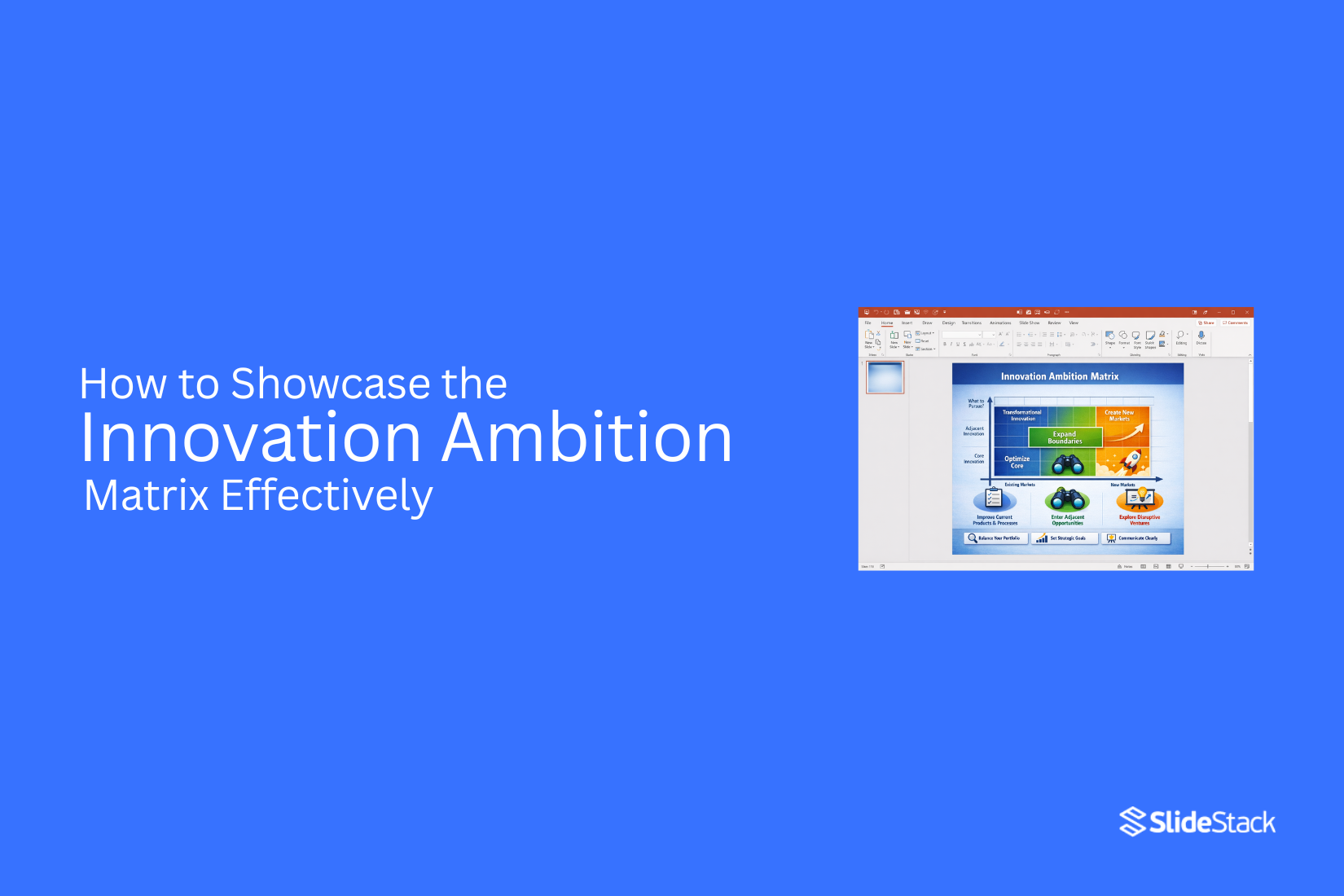
The Innovation Ambition Matrix is a strategic planning tool used to organize innovation efforts across three horizons: core improvements, adjacent growth, and long-term exploration. In presentations, it helps teams show how resources and ideas are balanced across short-term delivery, medium-term expansion, and future opportunities. It gives structure to decisions about what to prioritize, what to scale, and what to test. Without a clear presentation, the matrix can feel abstract and difficult to apply in real planning discussions.
This article explains how to showcase the Innovation Ambition Matrix in a clear and practical way. It follows a structured approach that fits executive meetings and strategy sessions. You will see how to present each horizon, avoid common mistakes, and connect the framework to real business decisions.
What is the Innovation Ambition Matrix?
The Innovation Ambition Matrix is a strategy tool created by Bansi Nagji and Geoff Tuff. It helps companies sort and manage their innovation work. It shows how much change each idea brings and what the goal is behind it.
It breaks innovation into three levels. These are core, adjacent, and transformational. Each level shows a different amount of change, risk, and purpose.
Core innovation focuses on improving current products, services, or processes. It works inside existing markets. It supports steady performance and small improvements.
Adjacent innovation moves into areas that are close to the current business. It may target new markets or new uses for existing strengths. It carries more change than core work, but still stays connected to what the company already knows.
Transformational innovation focuses on new ideas that are very different from current work. It may lead to new products or new business models. It involves the highest level of change and risk.
The three levels show a path from small change to large change. Core stays close to today’s work. Adjacent expands into nearby areas. Transformational builds something new.
This matrix connects with the Three Horizons Model. The Three Horizons Model looks at time. It separates work into short-term, mid-term, and long-term focus.
The Innovation Ambition Matrix focuses on intent. It groups ideas by how much change they create, not by timing.
One model explains when work may happen. The other explains what kind of change the work represents. Used together, they help balance focus across stable improvement and long-term growth.
Why the Innovation Ambition Matrix Matters
Most organizations lean toward safe work. Teams keep improving existing products. They focus on quick wins. New ideas that carry risk often stay on the side. Over time, this creates an imbalance. Growth slows. Future options shrink.
The Innovation Ambition Matrix helps address this pattern. It gives a clear way to sort and manage different types of work. It helps leaders see where effort is going. It also helps shape where effort should go next.
It acts as a control system for decision-making. It brings structure to work that often feels scattered.
Strategic Clarity
Many teams use the word innovation in different ways. One group may mean small product updates. Another may mean new business models. This creates confusion. It also creates mixed expectations.
The matrix solves this by separating work into clear categories. Each type of work gets a defined role. This reduces guesswork. It helps leaders and teams speak the same language.
Clear categories also improve planning. Teams know what success looks like for each type of work. A small improvement is not judged like a new market entry. Each effort gets a fair evaluation based on its role.
This clarity also improves communication. Leaders can explain priorities with less friction. Teams can understand where their work fits in the bigger picture. This reduces conflict and wasted effort.
Portfolio Balance
Most organizations naturally focus on core activities. These are the products and services that already generate revenue. They feel safe. They are easier to measure. They are also under constant pressure to perform.
This creates a structural bias. Too much effort stays in the core. Medium and long-term work gets less attention. Over time, this can reduce future growth options.
The result is a slow erosion of expansion opportunities. Small improvements continue, but bigger leaps become rare. The organization starts relying too much on existing success.
A common reference point for balance is the 70/20/10 split.
• 70 percent focuses on core improvements
• 20 percent focuses on adjacent opportunities
• 10 percent focuses on new and uncertain areas
This split is not a fixed rule. It works as a guide for discussion. It helps leadership teams test whether the portfolio feels balanced or not.
The key value is awareness. Without a structure like this, most organizations drift toward the 70 percent zone and stay there.
Strategic Alignment
Different types of work need different levels of support. Some need steady funding. Some need flexible funding. Some need protection from short-term pressure.
The matrix helps connect these needs to business goals. It gives leaders a way to match effort with direction.
Funding decisions become clearer. Resources can be allocated based on category, not just urgency. This reduces reactive spending.
Risk also becomes easier to manage. High-risk work is visible instead of hidden. Leaders can see how much uncertainty the organization is carrying at any time.
Performance tracking also improves. Each category can be measured in its own way. Core work can focus on efficiency and reliability. New areas can focus on learning and progress over time.
This structure creates stronger control across the full portfolio. Leaders gain a clear view of where the organization is strong and where it is exposed.
Closing Idea
The Innovation Ambition Matrix does not add complexity. It reduces it. It replaces unclear thinking with a defined structure. It shows how different types of work connect to growth.
With this view, leadership decisions become more stable. Resources are easier to guide. Progress becomes easier to track. The organization gains a clearer sense of direction across all levels of work.
The Biggest Mistake When Presenting the Matrix
Many presentations fail at this point. The idea looks clear on the slide. The message feels weak in the room. The problem is not the tool. The problem is how it is used.
The Innovation Ambition Matrix should show direction. It should show choices. It should show focus across time. Instead, it often becomes a slide full of labels and boxes with no meaning behind them.
That gap between structure and meaning is where most presentations break down.
Treating It as a Static Framework
A common issue starts here. The matrix gets treated like a fixed chart. It sits on the slide as a diagram to fill in.
Teams place projects into boxes. Short term, medium term, long term. Core, adjacent, transformational. Then the work stops there.
The audience sees placement, not purpose. There is no sense of movement or intent. Nothing explains why a project sits in a box or where it is going next.
The matrix loses its role as a decision tool. It becomes a storage map instead of a strategy view.
Overloading with Definitions Instead of Insights
Another problem shows up in how it is explained. Presenters often focus on what each section means. They repeat definitions. They explain labels. They walk through the structure step by step.
This fills time but adds little value.
The audience does not need more labels. They need direction. They need to see what choices are being made and what trade-offs exist.
Too many definitions hide the real story. The message becomes heavy and hard to follow. The matrix ends up looking complex even when the idea behind it is simple.
The Innovation Ambition Matrix Framework
The Innovation Ambition Matrix is a planning tool used in strategy work. It helps place work into three time horizons. It also helps show how effort is spread across different types of work.
Horizon 1 focuses on small improvements. These changes improve current products and services. The goal is steady performance and reliability. Horizon 2 focuses on new market areas. These are related to what already exists. The goal is growth through expansion into nearby segments.
Horizon 3 focuses on early-stage ideas. These ideas sit far from current offerings. They carry higher uncertainty and longer timelines. In presentation work, the matrix is often shown as a simple slide. It helps teams explain what is being built now and what comes next. It also shows where future work may sit. The structure shifts attention away from departments. It focuses instead on intent. It also highlights risk level and expected return for each area of work.
Clarifying the Role of Each Horizon
Each horizon plays a different role in the wider plan. Horizon 1 supports stability. It keeps core products strong. It also helps fund other work through steady results. Horizon 2 acts as a bridge. It connects current offerings to new areas. It supports growth beyond existing markets.
Horizon 3 supports long-term change. It focuses on early ideas and new directions. These efforts often need time before results appear. The value of this structure comes from clear use. Each horizon must link to a strategy. Expectations must match the level of risk. Limits and resources must also stay realistic.
Types of Innovation Ambition Matrix Presentations
The Innovation Ambition Matrix appears in different presentation formats across organizations. Each format supports a specific decision need. The structure stays the same, yet the intent changes. Leaders adjust how they use the model based on what they need to decide and communicate.
Corporate Innovation Strategy Presentations
This format supports executive planning work. It helps leadership teams review how innovation efforts are spread across time horizons.
The matrix acts as a diagnostic tool. It shows balance across short-term, mid-term, and long-term work. It also highlights where effort is missing or uneven.
In many cases, this appears early in strategy discussions. It sets a shared view of current activity before deeper planning starts.
Key output areas:
• Current innovation mix across horizons
• Gaps between present focus and desired direction
• Pressure points in long-term planning
The result often leads to changes in how resources are spread. Some areas receive more support. Others are slowed or reviewed for fit with the strategy.
Product Portfolio Realignment Presentations
This format focuses on managing a set of products or services. The matrix helps sort offerings by level of ambition and time focus.
Each product is placed into a hierarchy based on its role in the business. Short-term products often show stable performance. Mid-term products show growth potential. Long-term items carry higher uncertainty.
Context usually includes performance data, market movement, and customer behavior signals. These inputs shape how each product is viewed within the matrix.
Typical actions that follow:
• Moving investment toward stronger growth areas
• Reducing support for low-fit products
• Increasing testing in new or uncertain spaces
The matrix becomes a guide for portfolio decisions. It supports clearer choices on where effort should go next.
Startup Pitch and Growth Roadmap Presentations
This format supports external communication, often with investors or partners. The matrix becomes part of a story about growth over time.
The focus shifts from analysis to narrative. The startup uses the structure to show present stability, near-term growth plans, and long-term direction.
Each horizon plays a role:
• Short-term work shows current traction and delivery
• Mid-term work shows expansion plans and scaling paths
• Long-term work shows future market potential
The goal is to build trust in direction and execution ability. The structure helps explain how early actions connect to later outcomes.
Across all three formats, the same framework takes on a different meaning. The shift depends on decision needs, audience expectations, and the level of detail required.
Evaluation Criteria for the Innovation Ambition Matrix
To use the Innovation Ambition Matrix in a clear way, organizations apply fixed evaluation criteria for every idea. Decisions do not rely on opinion or guesswork. Each initiative is reviewed through four main dimensions: strategic alignment, market uncertainty, capability stretch, and financial expectations.
Strategic alignment looks at how an initiative fits the current business direction. Some ideas stay close to the core business. Some extend into related areas. Some move into new spaces. Market uncertainty checks how clear the demand is, how clear the competition is, and how much customer insight is available. Capability stretch measures how much change is needed in skills, systems, and operations. Financial expectations focus on the timing of returns, cost needs, and expected return level.
Horizon 1 initiatives show strong alignment with the current business model. They have low market uncertainty and small capability change. They also support near-term financial returns. Horizon 2 initiatives sit in a middle space. They show moderate alignment, moderate uncertainty, and need some capability growth. Financial returns usually appear in the medium term. Horizon 3 initiatives sit far from the current model. They show high uncertainty and need major new capabilities. Financial returns take longer, and learning outcomes carry more weight than short-term profit.
Common Mistakes When Using the Innovation Ambition Matrix
The Innovation Ambition Matrix helps sort innovation work into clear horizons. Many teams misuse it. That weakens planning. It also blurs strategic intent. The result is a portfolio that looks balanced on paper but does not work in practice.
Misclassifying Incremental Work as Transformational
Some teams label small improvements as major changes. This inflates ambition on paper. It creates a false sense of progress. The impact is clear. Leaders think the portfolio is more advanced than it is. Resources get misdirected. Real transformation work loses focus. The correction is a strict classification. Horizon 3 must reflect a real business model change. It must show work that breaks from current systems, not small upgrades.
Treating Horizon 3 as a Side Project
Horizon 3 work often sits outside core governance. It runs with weak support. It also gets limited attention. This leads to stalled progress. Ideas remain stuck in early stages. Teams lose direction. The correction is structured support. Horizon 3 needs executive sponsorship. It also needs clear learning targets. Small milestones keep progress visible and steady.
Applying the Same KPIs Across All Horizons
Some organizations measure all horizons the same way. That creates poor signals. Short-term work needs efficiency metrics. Long-term work needs learning metrics. Using one system across all horizons distorts results. The impact is poor decision-making. Teams optimize for the wrong outcomes. The correction is separate measurement logic. Horizon 1 tracks performance and delivery speed. Horizon 2 tracks validation and growth signals. Horizon 3 tracks learning progress and concept testing.
Overconcentrating Investment in Horizon 1
Many portfolios lean too heavily on current business activity. This feels safe. It also feels stable. The impact is slow decline in future readiness. New growth paths do not form. The business becomes exposed to disruption. The correction is balanced allocation. Resources must spread across all three horizons. Future-focused work needs protected funding, not leftover capacity.
Confusing Time Horizon with Risk Level
Some teams think longer time equals higher risk. That creates wrong classifications. Time does not define innovation type. Strategic distance does. The impact is misplacement of projects in the portfolio. Some high-change ideas get treated as simple long-term plans. The correction is clear logic. Horizon placement must reflect business model change, not timeline length. A near-term project can still be highly disruptive.
Failing to Update the Matrix Regularly
Many matrices stay unchanged for long periods. Markets shift faster than planning cycles. The impact is outdated portfolios. Decisions rely on old assumptions. Strategic alignment weakens over time. The correction is regular review cycles. The matrix must be revisited often. Changes in market signals and internal progress must feed into updates.
Ignoring Capability Gaps
Some portfolios assume execution capacity already exists. That assumption breaks down in advanced innovation work. The impact is delivery failure. Teams start work they cannot support. Progress slows or stops. The correction is capability planning. Each horizon needs matching skills and systems. Investment in capability must run alongside innovation planning.
Final Notes
The Innovation Ambition Matrix moves beyond a visual chart. It becomes a way to manage how decisions are made across the organization. It defines how effort is divided across current work, new market moves, and future-focused bets. It sets a structure for how leadership assigns focus and direction.
A steady challenge sits inside this structure. The organization must manage uncertainty while keeping core operations stable. Both sides pull attention in different directions. One side demands steady delivery. The other side demands movement into unknown areas.
Two risks appear from the imbalance. Over-focusing on small improvements slows progress over time. The organization keeps refining what already exists and loses forward movement. Over-focusing on large change without a clear structure creates instability. Resources are stretched too thin. Core performance weakens.
The main value of the matrix lies in how it organizes attention, capital, and leadership focus. It makes resource use visible and deliberate. Decisions about effort no longer sit in isolation. They sit within a shared structure that shows tradeoffs clearly.
The strongest outcome appears in how it shapes leadership behavior. The matrix turns into a system that guides governance across teams. It sets boundaries for discussion and decision-making. It aligns planning with execution in a consistent way.
Clear use of this system depends on regular updates. It also depends on separate measures for different types of work. Each part of the portfolio needs its own way to track progress. Without that separation, the structure loses meaning and blends into general reporting. Over time, the matrix shifts from a planning tool into a control system for strategic direction.
FAQs:
What is the Innovation Ambition Matrix?
The Innovation Ambition Matrix is a way to plan how a company uses its money and effort across different types of work. It splits work into three areas: improving current products, expanding into nearby areas, and building new future ideas. This helps teams see where they are focusing too much or too little. It gives a simple view of balance in planning.
How is the Innovation Ambition Matrix different from the Three Horizons Framework?
The Innovation Ambition Matrix focuses on how money and effort are split across different levels of work. The Three Horizons Framework focuses more on time and how ideas grow over short, medium, and long periods. The matrix is often used for budgeting and planning resources. The framework is often used for strategy and long-term thinking.
What is the ideal investment ratio across the three horizons?
A common guide is 70 percent for current work, 20 percent for near-term growth, and 10 percent for future ideas. This balance keeps the main business strong while still supporting growth and new ideas. Some companies adjust these numbers based on their goals. There is no single fixed rule for every business.
Can small or early-stage companies use the Innovation Ambition Matrix?
Yes, small and early-stage companies can use it. They usually focus more on current work and near-term growth. Very early companies may not invest much in future ideas yet. The model still helps them plan where to put effort.
How often should the Innovation Ambition Matrix be updated?
Many companies review it every few months or at least once a year. Faster-moving businesses may check it more often. Updates help match changes in goals or market conditions. Regular review keeps planning clear and current.
Who should own Horizon 3 initiatives?
Horizon 3 work is often led by senior leaders, research teams, or dedicated innovation groups. These teams focus on long-term ideas that are not ready for the main business yet. They also test early concepts before wider use. Support from top leadership helps these efforts move forward.
What risks arise from overinvesting in Horizon 1?
Too much focus on Horizon 1 can limit future growth. The company may improve current products but miss new opportunities. Over time, this can make it harder to compete with faster-moving businesses. It can also reduce new idea development.
What tools work alongside the Innovation Ambition Matrix?
Portfolio planning charts help track where resources go. Roadmaps show how projects move over time. OKRs help set clear goals for teams. Stage-based planning systems also support tracking progress across different types of work.


You may also be interested in ...

How To Create An Eye-Catching Portfolio
If you’re looking to create an eye-catching portfolio, this post will come in handy. In this article, you can find the easies...
23 Jun, 2024

How To Easily Create An Infographic
Infographics are the perfect way to make a presentation that will impact an audience, but their design and composition might...
08 Jun, 2024

PowerPoint Template Tips & Tricks You Ne...
PowerPoint seems to be an unknown world for many people, especially those who have been assigned to create a presentation out...
08 Jun, 2024